



China compresses more impossible landscapes into one country than anywhere I’ve traveled. Some I’ve now filmed, others are locked on my shortlist for the next trip. All eight belong on any list of places that look rendered rather than real.
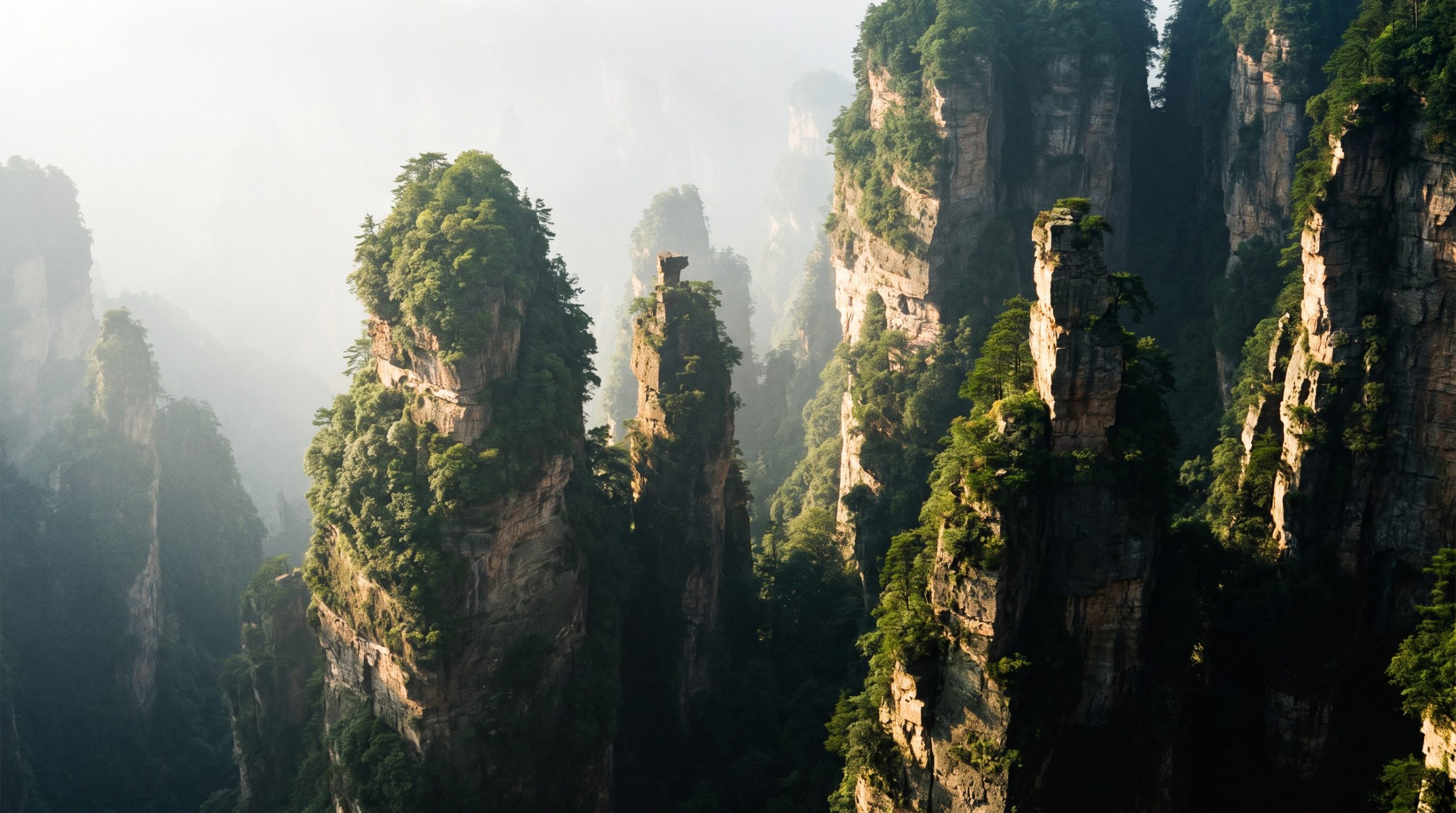
1. Zhangjiajie’s Stone Pillars
Three thousand sandstone towers rising out of subtropical mist, the landscape that inspired Avatar’s floating mountains, except it’s just standing there in Hunan being real.
2. Chongqing After Dark
A megacity built vertically into river gorges: monorails passing through apartment blocks, streets stacked five layers deep, neon canyons. The most science-fiction urban environment on the planet, and most of the world has never heard of it.
3. The Li River at Guilin
Karst peaks repeating into haze while bamboo rafts drift the green water. It’s on the 20-yuan banknote, and the banknote undersells it.
4. Zhangye’s Rainbow Mountains
Striped mineral ridges in ochre, rust and cream, geology doing color grading. No filter has ever needed to be applied less.
5. The Great Wall at Jinshanling
Skip the restored crowds at Badaling: here the wall rides wild ridgelines into the distance, half-ruined and completely cinematic, often with more watchtowers than tourists.
6. Shanghai’s Skyline From the Bund
The one I keep returning to. A century of history on one bank staring at a century of future on the other. It still doesn’t look real, and I’ve stood there a dozen times now.
7. West Lake, Hangzhou
Mist, willows, arched bridges, pagodas on islands, the landscape Chinese painters spent a thousand years perfecting, unchanged enough that the paintings still work as maps.
8. Harbin in Ice Season
Every winter an entire city of illuminated ice palaces is built from scratch, then melts. Ephemeral megastructure as annual tradition.
The takeaway after two trips this year: China isn’t one destination. It’s thirty countries wearing one visa.