



My entire production company fits under an airline seat. That’s not minimalism as aesthetics, it’s survival. Checked bags miss connections; my career doesn’t get to.
Here’s what’s actually in the bag in 2026, and the thinking behind every slot.
The Camera
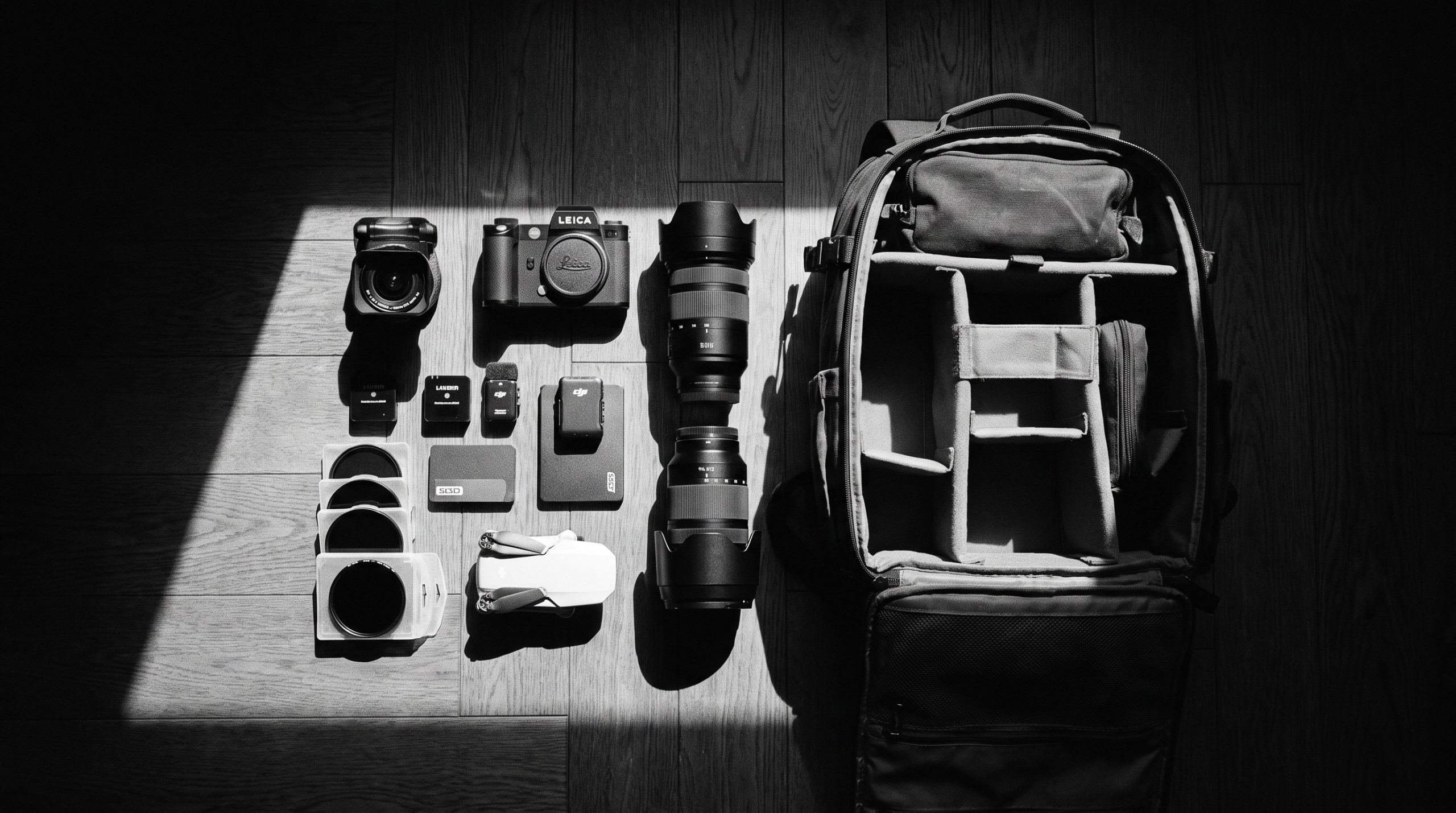
One full-frame mirrorless body. Not two, one. A second body is weight I’d carry every day for a failure that’s happened to me once in a decade. If disaster strikes, every city on Earth rents cameras.
Lenses: Two, Not Six
A 24-70mm f/2.8 that lives on the camera and covers 90% of everything, and one fast prime for low light and portraits. Every lens beyond two is a decision tax you pay dozens of times a day.
The Drone
A DJI compact drone, the single biggest production-value multiplier per gram in the bag. Ten years ago the aerial shots I get before breakfast required a helicopter budget. I check every country’s rules before flying; more on that in a future post, because China deserves its own chapter.
Audio
Two wireless mics the size of a coin and a tiny shotgun on the hot shoe. Audiences forgive imperfect image. They do not forgive bad audio.
The Unglamorous Essentials
ND filters (non-negotiable for video in daylight), five batteries, a charging brick, two fast SSDs. Every card gets dumped to both drives nightly, and one drive never sleeps in the same bag as the other. Paranoia is just professionalism with scars.
What I Stopped Carrying
A tripod (a mini one and a wall do the job), a laptop stand, a second drone battery charger, filters I used twice a year. Every trip, the bag gets lighter. The rule that governs it all: if an item hasn’t earned its place in three trips, it stays home.
Gear matters less than the willingness to be somewhere worth pointing it at. But when you’re 9,000 kilometers from home, the right small bag is the difference between a story and an excuse.